
Silver Jewelry Wholesale: Sampling at 25–30 Days
The 25–30 day sampling window is the longest fixed block in a silver programme, and it is the one buyers plan least carefully. It follows CAD at under 48 hours and precedes 3–4 weeks of bulk production, which puts the sample at roughly half of the total 48–60 day schedule. Treating it as a waiting period rather than a decision point is how launches slip a quarter.

Key takeaways
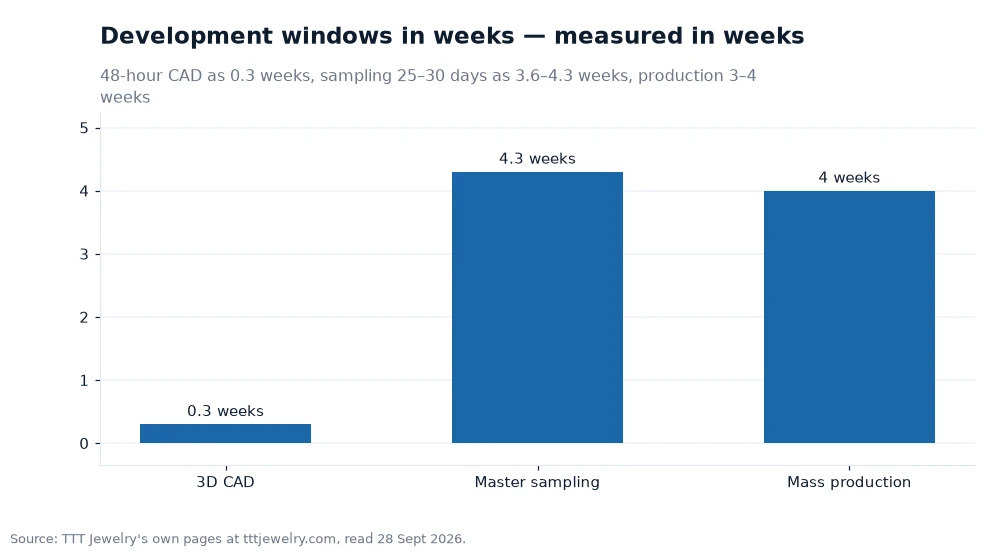
- Sampling at 25–30 days equals 3.6–4.3 weeks, against 2 days of CAD and 3–4 weeks of production.
- Sampling occupies 50–52% of the 48–60 day end-to-end window, so a slip there moves the ship date one for one.
- A second sample round adds 25–30 days, taking the same order to 73–90 days.
- Approval should test weight, dimensions, stone seats, clasp action and plating colour under daylight, not just appearance.
What the 25–30 days are spent on
A master sample is a small production run with most of the same steps as bulk. The mould or the 3D print is made first, then the piece is cast or grown, the sprue is cut, the surface is filed and polished, settings are opened, plating is applied and the finished unit is inspected. Each step involves a bench, a person and a queue.
The window is quoted as a range because the steps do not compress evenly. A plain band moves through in the lower half of the range; a piece with a stone seat, a hinge or a two-tone finish spends longer at the setting bench and again at plating. A design that combines several of those features sits at 30 days rather than 25.
That is why the sample date should be quoted per design, not per order. Five simple designs and one complex one do not share a single date unless the sample bench runs them in parallel, and parallel capacity is finite. A schedule that assumes all six finish together is a schedule built on optimism.
The output of the window is a physical object plus a decision. The object can be measured; the decision cannot be delegated to a photograph. Buyers who approve from an image frequently discover the difference at bulk inspection, when the weight or the clasp action has already been multiplied across the run.
CAD at 48 hours starts the clock
Modelling is quoted at under 48 hours, which is 2 days. That figure only holds when the brief is complete: dimensions, stone sizes, wall thickness, finish per surface and the mark position. An incomplete brief does not stop the clock so much as reset it, because the model has to be rebuilt rather than adjusted.
Two days looks trivial beside thirty, but it decides what the sample tests. A model that omits a seat depth will produce a sample that cannot hold the stone, and the fault will be discovered four weeks later at the bench rather than in the file. Correcting it means a second round, not a second file.
The CAD stage is also where weight is set, and 925 sterling silver shows the error earliest because the finished piece is weighed before plating. Volume in the model becomes grams in the metal, and grams are what a customer feels. A buyer who wants a 4 g ring rather than a 3 g ring has to say so before the model is signed off, because adding metal after casting means recutting the mould.
For buyers ordering private label sterling silver jewelry, the practical rule is to approve the CAD in writing and keep the approved file. Every later disagreement about proportion traces back to that file, and a version history settles it faster than a conversation.
The approval meeting is the real deadline
A sample in 925 sterling silver is approved on evidence, not on impression. Weight on a scale, dimensions against the drawing, stone seats checked with the actual stone, clasp opened and closed a set number of times, plating colour compared under daylight rather than office light, mark read at magnification. Each test produces a yes, a no, or a note.
A note is not an approval. The most common schedule failure is a buyer who says "looks good, just make the band a little thicker" and assumes production has started. In practice that instruction reopens the model, and the sample clock restarts at 25–30 days.
Two categories of change behave differently. Surface changes — a different polish, a satin finish on one panel — can often be handled inside the existing sample without a full rebuild. Structural changes — a new shank profile, a different stone size, a moved hinge — need a new model and a new sample. Sorting a request into one category or the other is the difference between a two-day adjustment and a five-week one.
Record the approval date. The production window of 3–4 weeks begins from that date, not from the sample's arrival, and not from the purchase order. A factory that starts counting from the wrong event will quote a delivery date the bench cannot meet.
What the sample has to prove
A sample is a test of the specification, not a preview of the product. The table lists what each check is for and what it prevents at bulk stage.
| Check | Method | Fault it prevents |
|---|---|---|
| Weight | Gram scale against the CAD estimate | Hollow or thin sections that reach the customer |
| Dimensions | Caliper against the drawing | Stones that do not seat, bands that do not size |
| Clasp and hinge | Repeated open and close | Failures in the first week of wear |
| Plating colour | Daylight comparison with the approved chip | Batch-to-batch colour drift |
| Mark | Magnified inspection of position and depth | Stamps lost in polishing or buried under plating |
The MOQ gives each of those checks a price. At 50 pieces per design, one unchecked fault is a 50-piece rework, and reworking a plated surface means stripping, repolishing and replating the batch. The sample bench is the only place where the same correction costs one unit.
Photograph the approved sample from four angles and keep the images with the file. When the second production run arrives a season later, the photograph is the reference; the sample itself is usually on a shelf somewhere, slightly tarnished.
Worked example
Take a single design with a complete brief. CAD is under 48 hours, or 0.3 weeks. Sampling is 25–30 days, or 3.6–4.3 weeks. Production is 3–4 weeks, or 21–28 days. Fast path: 0.3 + 3.6 + 3 = 6.9 weeks, about 48 days. Slow path: 0.3 + 4.3 + 4 = 8.6 weeks, about 60 days.
Sampling's share of that total is 25 ÷ 48 = 52% at the fast end and 30 ÷ 60 = 50% at the slow end. Whichever path the order takes, the sample is roughly half the calendar, which means a one-week delay at approval is not absorbed anywhere else.
Add a second round and the arithmetic changes shape: 2 + 30 + 30 + 28 = 90 days, or 12.9 weeks, against 48–60 days for a single round. On a 50-piece order the sample cost is small in cash and large in calendar, and the calendar is what a launch date is made of.
Frequently asked questions
Can the sampling window be shortened?
It is published at 25–30 days and the range already reflects design complexity, so the useful lever is a complete brief that avoids a second round rather than pressure on the bench.
Does a colour change require a new sample?
A finish change on the same geometry can often be shown on a second plated sample without a new model, while a change to size, profile or stone setting requires a rebuilt sample.
When does bulk production start?
Production of 3–4 weeks begins from written sample approval, so the approval date rather than the order date is the one to put in a launch plan.
Building the sample date into the launch plan
Work backwards from the ship date: 21–28 days of production, then 25–30 days of sampling, then 2 days of CAD. A launch that allows nine weeks from brief to dispatch has no slack for a second round, and a launch that allows twelve has room for one.
Suppliers who publish their windows make this planning possible. TTT Jewelry lists the three stages separately, which is more useful than a single lead time because each stage has a different owner and a different failure mode.
Where the schedule is tight, the alternative is a metal that needs less finishing. The stainless steel jewelry manufacturer route still samples, but PVD plating is a vacuum step rather than a multi-pass tank sequence, which shortens the plating queue inside production.
Source note: figures come from the manufacturer's own website (tttjewelry.com), read 28 Sept 2026.[1]