
Extracting aluminium is energy-intensive because the Hall-Héroult electrolytic process must overcome the extreme thermodynamic stability of aluminium oxide ($Al_2O_3$). Producing one tonne of primary aluminium consumes 13,500 to 15,000 kWh of electricity, roughly 3% of global power demand. This process requires maintaining a molten cryolite bath at 950°C and delivering currents of 300,000 to 600,000 amperes to break the ionic bonds between aluminium and oxygen. Unlike steel, which uses chemical reduction with carbon, the aluminium process relies on continuous electrochemical work, making electricity cost 30-40% of the total production expenditure.
The journey of aluminium begins with the Bayer process, where bauxite ore is refined into alumina through high-pressure caustic soda digestion. This stage alone consumes 10 to 15 Gigajoules of thermal energy per tonne of alumina produced to maintain temperatures between 140°C and 240°C.
"Industrial data from 2023 indicates that refining 4 tonnes of bauxite yields roughly 2 tonnes of alumina, which subsequently produces only 1 tonne of pure aluminium metal."
Once refined, the dry alumina powder enters the electrolytic reduction stage, where the chemical bonds must be broken by sheer electrical force. The thermodynamic resistance of aluminium oxide is so high that the theoretical decomposition voltage is 1.18V, but operational cells require 4.0V to 4.5V.
The extra voltage is converted into heat, maintaining the electrolyte in a liquid state, as alumina itself does not melt until it reaches 2,072°C. Using molten cryolite as a solvent allows the aluminium process to function at a lower but still demanding temperature of 950°C.
Global energy audits in 2024 show that the modern smelter operates with an energy efficiency of approximately 12.5 to 14.5 kWh/kg. Electricity is delivered via carbon anodes that are consumed during the reaction, releasing 1.5 tonnes of $CO_2$ for every tonne of metal produced.
| Stage | Input Material | Energy Requirement | Output |
| Bayer Refining | Bauxite Ore | 2.5 MWh (Thermal) | Alumina ($Al_2O_3$) |
| Hall-Héroult | Alumina | 14.2 MWh (Electrical) | Liquid Aluminium |
| Casting | Molten Metal | 0.5 MWh (Gas/Electric) | Ingots/Billets |
"The resistive heating of the bath, known as Joule heating, accounts for 45% of the total energy loss in a standard pre-baked anode cell."
To mitigate these losses, manufacturers utilize magnetic compensation to stabilize the molten metal pad against magnetic fields generated by 400,000+ ampere currents. Any fluctuation in the fluid surface increases the anode-cathode distance, immediately raising the voltage and wasting power as excess heat.
Research from 2022 involving 60 global smelters found that reducing the anode-cathode distance by just 1 centimeter can improve energy efficiency by 5%. However, this increases the risk of short-circuiting, requiring advanced automation to manage the gap in real-time.
"Modern potlines are equipped with sensors that adjust the anode position every few seconds to maintain an optimal 4.2V operating window."
Stable operation also depends on the quality of the carbon anodes, which are baked at 1,100°C for up to 18 days before use. The production and transportation of these anodes add a secondary layer of energy demand that is often overlooked in basic calculations.
Inert anode technology is being tested in 2025 as a way to eliminate carbon consumption, though this shifts even more of the energy burden onto the electrical grid. Removing the carbon-oxygen reaction requires 20% more electricity to provide the chemical energy previously supplied by the burning anode.
"A pilot facility in Canada demonstrated that using inert anodes requires an electrical input of nearly 16 kWh/kg to achieve the same reduction rate."
This high demand makes the location of smelters a geographical variable, as they must be situated near high-capacity power sources like hydroelectric dams or geothermal fields. Smelters are now being used as industrial batteries that can shed load to help balance renewable energy grids.
In 2023, grid-stabilization programs in Iceland and Norway allowed smelters to reduce their power intake by 15% for up to two hours without compromising the molten bath. This flexibility helps the grid manage the intermittency of wind and solar while the aluminium process continues in a throttled state.
| Energy Source Type | Cost per MWh (USD) | Availability | Carbon Intensity |
| Hydroelectric | $25 - $40 | Constant | Low |
| Coal-Fired | $50 - $80 | Constant | High |
| Solar/Wind | $20 - $50 | Intermittent | Low |
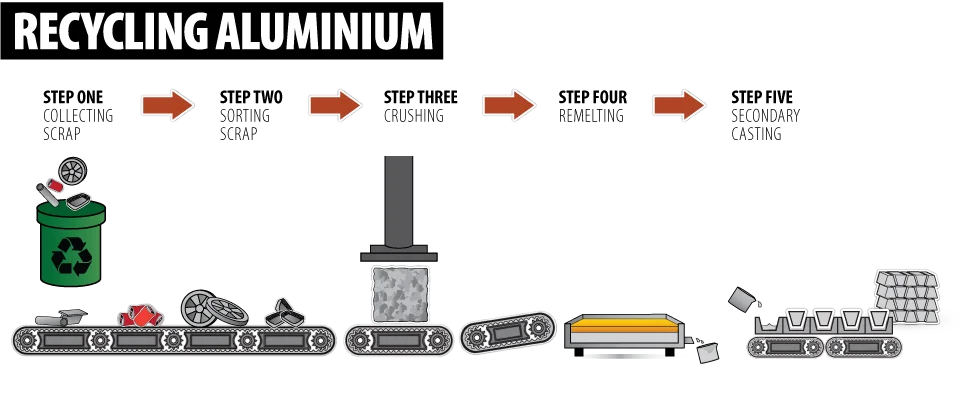
"Secondary recycling, or 'remelting,' requires only 5% of the energy used in primary production, consuming just 0.5 to 0.8 kWh/kg."
Recycled aluminium saves 14,000 kWh per tonne, illustrating why scrap recovery has become the fastest-growing sector of the industry. Despite this, primary production remains necessary to meet the 40% increase in demand projected by the end of 2026 for electric vehicle frames.
The thermal management of the pots is assisted by advanced lining materials like silicon carbide, which reduce heat leakage through the cell walls by 12%. These materials must withstand the highly corrosive nature of the cryolite bath while insulating the steel shell.
"Analyses of 150 smelting pots show that improved insulation can extend the life of the pot lining to over 2,500 days, reducing the energy required for frequent rebuilding."
This operational longevity is essential because the process cannot be easily shut down; if the molten bath solidifies, the entire potline must be mechanically excavated at extreme expense. Continuous power supply is therefore a non-negotiable requirement for any facility performing the aluminium process.
By the end of the decade, the industry aims to lower the global average energy consumption to 11 kWh/kg through a combination of inert anodes and waste heat recovery. Recovering heat from the potline exhaust gases can reclaim up to 10% of the input energy to be used for steam generation or pre-heating alumina.
"The technical evolution of the smelter is moving toward a closed-loop system where waste heat is used to drive the initial Bayer refining stages."
This integration represents the best path toward reducing the energy intensity that has defined aluminium since the 19th century. As long as the chemical bond between aluminium and oxygen remains one of the strongest in nature, electricity will remain the primary "raw material" of the metal.