
Sourcing perfume manufacturing in China is usually described as a search: find factories, compare quotes, choose one. It behaves much more like a sequence of decisions, and the order matters more than the effort. Brands that settle ownership, compliance and the specification before they argue about price get a cheaper programme overall, because they are not paying for rework. Brands that start with the unit price tend to rediscover every other decision later, at a higher cost, with the launch date already committed.
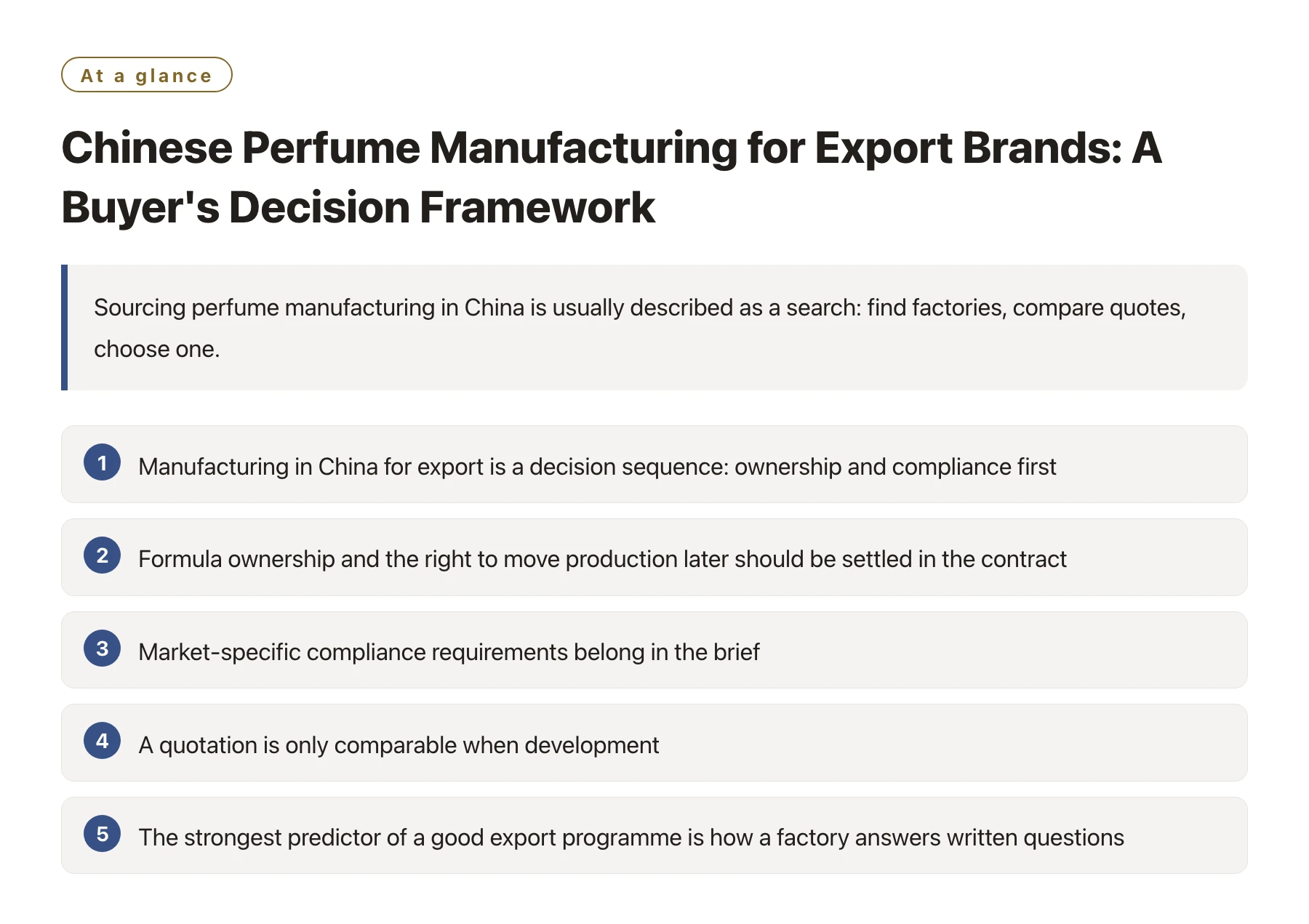
Key takeawaysManufacturing in China for export is a decision sequence: ownership and compliance first, specification second, price third. · Formula ownership and the right to move production later should be settled in the contract, because they are nearly impossible to renegotiate once the scent is developed. · Market-specific compliance requirements belong in the brief, since they constrain the formula as well as the label. · A quotation is only comparable when development, compounding, filling, packaging, decoration, testing and freight are itemised separately. · The strongest predictor of a good export programme is how a factory answers written questions, not how it answers a phone call.
For an export brand, a Chinese manufacturing partner is doing three jobs at once: developing or reproducing a scent, producing it to a consistent standard, and supplying the documentation that a foreign market requires. Those three jobs have different failure modes, and buyers who treat them as one purchase tend to discover the difference late.
This framework is written for an export brand owner or sourcing lead who is building a pharmacy-channel range and wants the decision order to do the work. It is deliberately not a list of factories or a price guide; it is the set of questions that make the rest of the process tractable.
What actually changes when production is offshore
The first change is distance, and its real cost is not freight but feedback. A question that would be answered by walking to the bench now takes a day, and a mistake that would be caught by eye now has to be caught by a document. Everything that can be written down should be written down, and everything that cannot should be turned into a photo, a video call or a sample.
The second change is that you are buying capability rather than capacity. A partner for Xuelei fragrance production is not just a filling line; it is a development bench, a compounding operation, a packaging supply chain and an export documentation process, and the balance between those four is what determines whether your programme runs. Ask which parts are in house and which are bought in.
The third change is regulatory reach. Products crossing borders meet market-specific requirements on ingredients, labelling and claims, and those requirements are not uniform, which is why compliance has to be treated as a design input rather than a final inspection [1]. A factory that exports regularly will already have a routine for this; a factory that mostly fills domestically will not.
Five decisions, and the evidence each one needs
| Decision area | What you are actually deciding | Evidence to ask for |
|---|---|---|
| Ownership | Who holds the formula, the artwork and the right to move production later | A written IP clause and, where relevant, a registration route for the brand asset [2] |
| Compliance | Which restriction framework the formula is built against, and what the label must carry | A named restriction list, allergen data and a document list that travels with each shipment |
| Specification | What counts as a conforming batch, including dosage, fill and pack tolerances | A specification template with numeric tolerances, plus the batch record format |
| Commercial structure | What is included in the unit price and what is billed separately | An itemised quotation covering development, compounding, filling, decoration, packaging and freight |
| Continuity | How a material change, a supplier swap or a capacity problem is communicated | A change-notification commitment, a named contact and a stated retention period for records |
Work down this table before you negotiate anything. Most of the difficult conversations in an export programme are easier when these five are already in writing.
The order to settle them in
- Anchor the brand assetDecide and document who owns the formula, the name and the artwork, and how that ownership survives a change of supplier.
- Fix the target marketsName the countries you will sell in first. Compliance follows the market list, and the market list follows your distribution, not your ambition.
- Write the specificationDosage, format, fill, closure, decoration, pack and tolerances, in numbers. This is the document every later argument refers back to.
- Run a comparable quotationAsk three suppliers for the same itemised structure, then compare line by line rather than in total.
- Test before you commit volumeUse the sample round and, where the channel requires it, independent laboratory testing to confirm stability and compatibility before the first large order [3].
- Set the change rulesAgree who may alter a material, a pack or a process, how you will be told, and what triggers a re-approval.
The parts buyers underestimate
Formula ownership is the most expensive thing to get wrong and the cheapest to get right. In many development arrangements the factory owns the work it creates unless the contract says otherwise, which means a brand that later wants to change suppliers may find that it cannot take its own scent with it. Settling this at the start costs a conversation; settling it later costs a negotiation.
Restrictions are the second. Fragrance materials carry usage limits set by safety assessment, and a formula has to be built within them rather than adjusted afterwards [4]. For a pharmacy channel this matters twice over, because the products sit beside categories where customers read labels and staff are expected to answer questions.
Packaging is the third and the most common calendar risk. Bottles, caps, pumps and cartons typically have longer lead times than the fragrance itself, and tooling for bespoke components adds a fixed cost that has to be carried by the first order. Buyers who pick a stock pack for the first run and a bespoke pack for the second usually get a faster launch and better information about real demand.
Experience is the fourth, and it is best judged in the answer rather than on the certificate. Xuelei is a Guangzhou fragrance and cosmetics manufacturer that states 31 years of production for export markets, which is a Chinese fragrance manufacturer since 1994 by its own account; for a buyer, the useful question is whether that history shows up as a pre-answered compliance pack and a routine for material changes, rather than as a number on a page.
Finally, decide early whether you want a partner that develops or one that reproduces. both OEM and ODM fragrance production are available from the same kind of factory, and the two carry different responsibilities: in one you bring the formula, in the other the factory helps create it and the ownership question gets sharper. Choosing deliberately is worth far more than choosing cheaply.
Whatever route you select, ask how the scent moves from formula to finished bottle before you sign. Knowing the stages of perfume production makes it much easier to spot a schedule that has no room for the steps that actually take time.
Send the same written question set to every candidate, including the ones you already like. The value is not only in the answers; it is in the fact that a written set creates a record, and a record is what you will rely on when a shipment, a scent or a claim is questioned twelve months from now.
Sources
- European Commission: Cosmetics in the EU —— The European Commission's overview of EU cosmetics rules, including the responsible person, product information file and safety report requirements.
- WIPO — World Intellectual Property Organization —— The UN agency for intellectual property; resources on industrial design and patent protection relevant to product and packaging design.
- SGS: Cosmetics, Personal Care & Household Testing —— Testing, inspection and certification services for cosmetics and personal care, including microbiological, stability and safety testing aligned with cosmetics GMP.
- IFRA Standards Library (International Fragrance Association) —— The IFRA Standards Library lists the restrictions the fragrance industry applies to individual fragrance ingredients, based on safety assessments; it is the reference point for compliant fragrance formulation.
Frequently asked questions
Is manufacturing perfume in China suitable for small brands?
It can be, provided the brand accepts the factory's minimum order quantity for the chosen format and pack. Small runs are usually constrained by packaging minimums rather than by the fragrance itself.
Who owns the formula when a Chinese factory develops the scent?
That depends on the contract. Many development arrangements leave ownership with the party that created the work unless it is assigned in writing, so the ownership clause should be settled before development begins.
What documents should travel with an export shipment?
Typically a specification, batch record extract, safety and allergen data, labelling content and any certificates the destination market or channel requires. Agree the list in advance so nothing is assembled under time pressure.
How do we compare quotes from different factories?
Insist on the same itemised structure from each: development, compounding, filling, decoration, packaging, testing and freight. Only then does the difference between two totals become explainable.
How long does an export launch usually take?
It depends on the pack and the sample rounds, which is why a written schedule with your own inputs marked on it matters more than a quoted number of weeks. Ask what the factory needs from you, and by when.